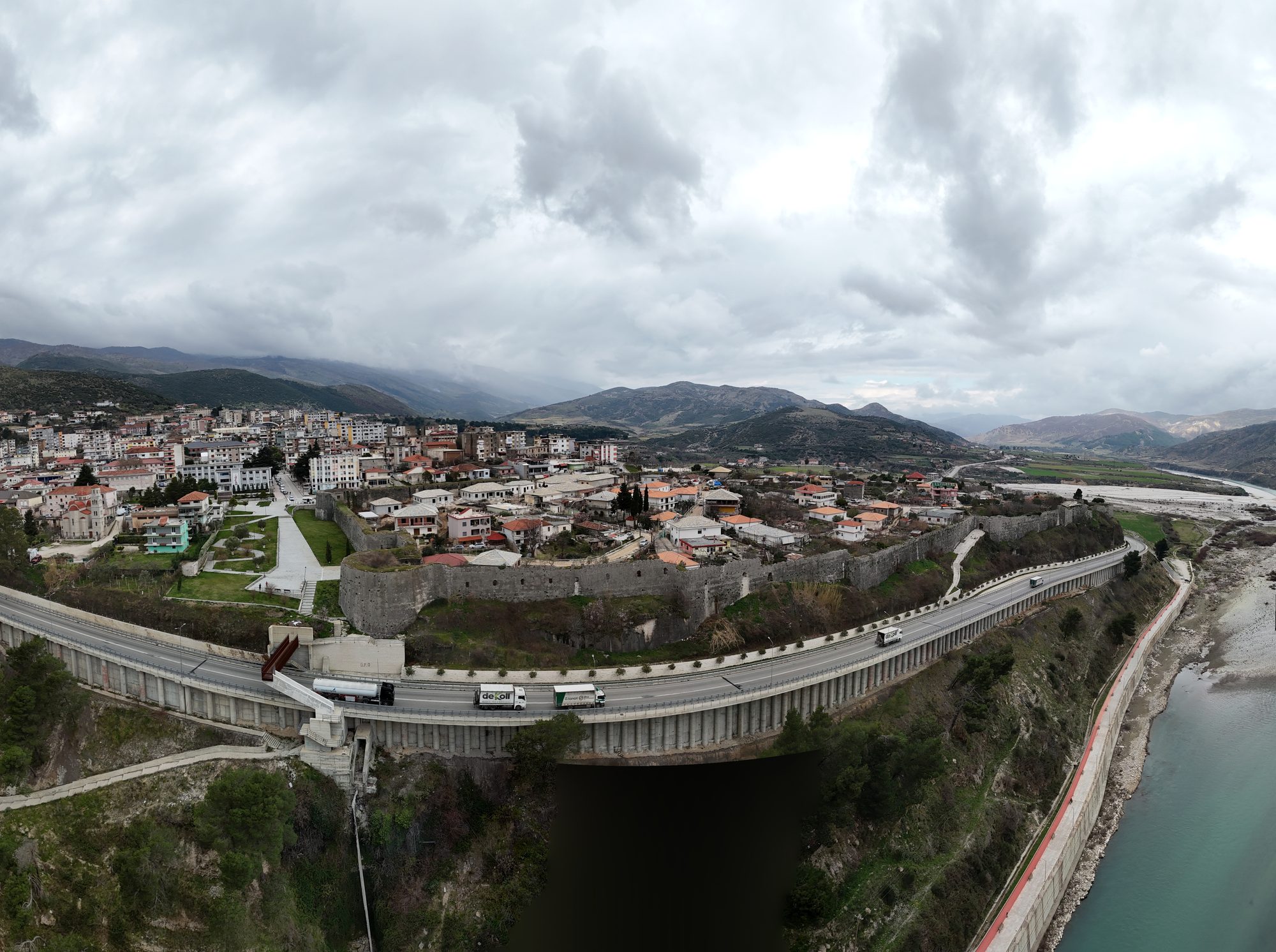
Gjirokastër is built of one material, and it announces the fact from across the valley. Grey limestone walls, grey slate roofs laid in overlapping scales, grey cobbles polished by four centuries of feet, all of it climbing a mountainside so steep that the houses had to become towers to stand on it. The Albanians call it Qyteti i Gurtë, the Stone City, and for once the nickname is a plain description.
It is a UNESCO World Heritage site, it is four hours south of Tirana and an hour from Sarandë, and it is the birthplace of both Enver Hoxha, who ran Albania for forty years, and Ismail Kadare, who wrote the novels that explained it to the world. That combination tells you most of what you need to know about the town: it produces people who leave, and it keeps their houses.
My first visit was in November, when fog came up the lanes and the cobbles shone, and I have never quite shaken the feeling that the town suits grey skies. It also suits an evening in June with the bazaar lit and a plate of qifqi in front of you. This guide is the practical version of both.
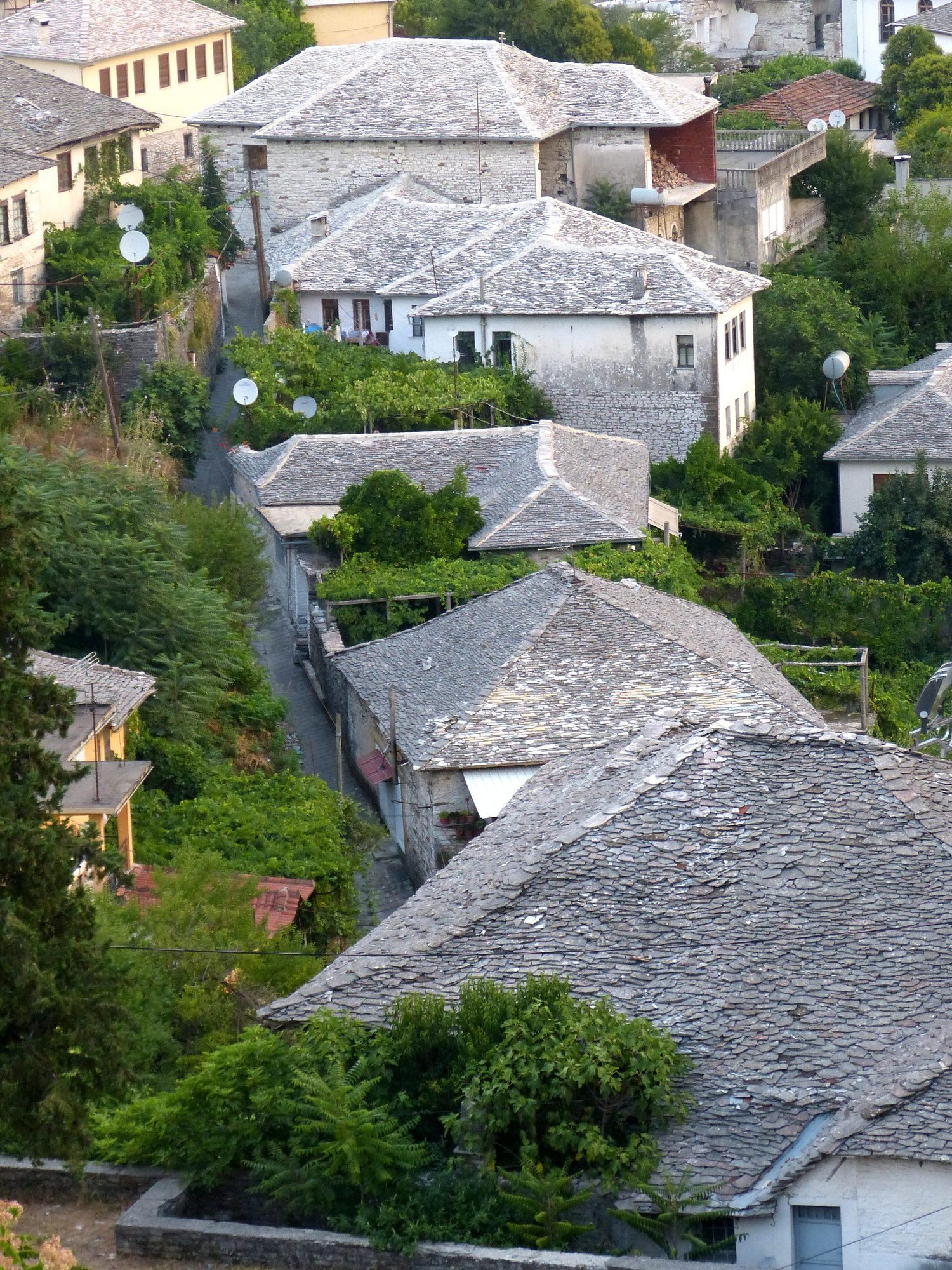

How the Town Is Laid Out
There are two Gjirokastërs. The new town sits on the Drino plain at the bottom, where the bus station, the supermarkets and the cheap hotels are. The old town climbs the mountainside above it, and everything you came for is up there.
The old town’s centre is Qafa e Pazarit, the Neck of the Bazaar, a five-way junction of cobbled lanes with the Bazaar Mosque of 1757 beside it. The bazaar was founded in the seventeenth century and rebuilt after a nineteenth-century fire, and its lanes fan out from the junction into the neighbourhoods: Palorto to the west with the grandest houses, Manalat below the castle, Dunavat, whose men once quarried the roof slates, and Varosh, Cfakë and Hazmurat spread around them.
Above all of it is the castle, and above the castle is Mali i Gjerë, the Wide Mountain, which is where the weather comes from.
The old town has more than five hundred protected houses, around four hundred of them still homes, and the honest state of them is mixed. Some are restored and glorious. Around fifty are close to collapse, tangled in inheritance disputes where a single house can have fifty owners, and you will walk past roofs with trees growing through them. The town is a monument and a place where people live, and the two are not always on the same side.
The Castle
Kalaja e Gjirokastrës is the most visited monument in Albania, with more than three hundred thousand people through the gate in 2025, and it earns it. Half a kilometre long along the ridge, fortified since before the twelfth century, extended by Ali Pasha of Tepelenë after 1812, and full of things that should not be there.
Entry is 400 lekë, cash only, with 200 for pensioners and 120 for students. From May to September it opens daily from nine to seven. From October to April it is Tuesday to Saturday nine to four, Sunday until two, and closed on Mondays. Allow two hours.
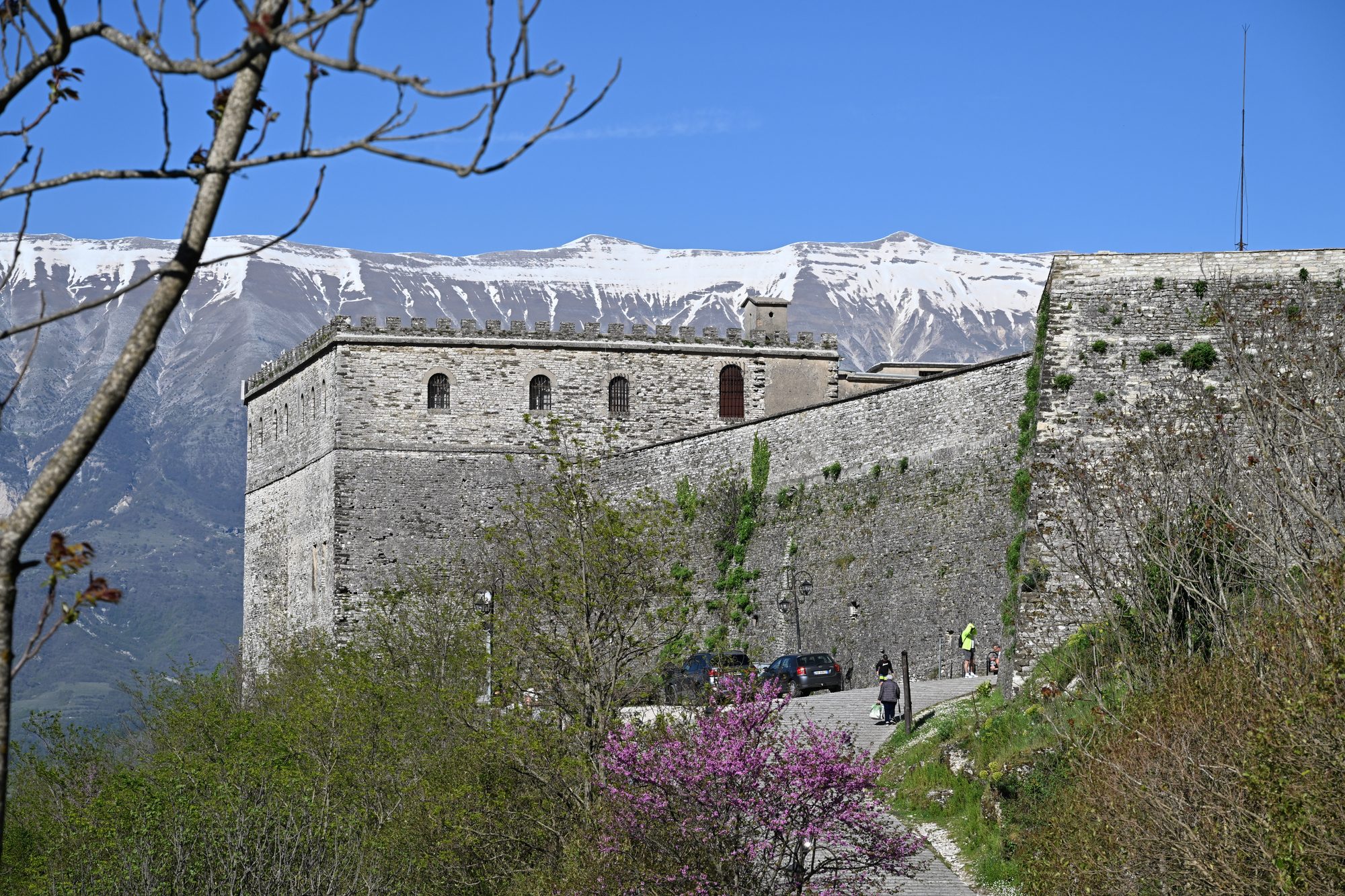

Inside, in order:
- The gallery of guns. A long vaulted hall lined with Italian and German artillery captured in the Second World War, which is the entrance to the National Museum of Armaments. The museum itself, opened in 1971 in part of the old prison, charges a separate 200 lekë, and visitors grumble about the two tickets. Pay it; the prison is the point.
- The prison. Built in 1932 under King Zog and used by every regime after him until 1968, including the communists for political prisoners. Cold, wet, and the single most sobering room in the south.
- The American jet. A Lockheed T-33 sits on the ramparts because in December 1957 its pilot, a US Air Force major, was intercepted by two Albanian MiGs and forced down at Rinas. Hoxha’s government displayed it as a captured spy plane and released the pilot a few weeks later. Whether he was lost in fog and short of fuel, as the Americans said, or spying, as the Albanians insisted, depends on who you ask in the bazaar.
- The clock tower, added by Ali Pasha, and the ramparts beyond it with the whole Drino valley laid out below.
- The festival stage. Every five years the castle hosts the National Folklore Festival, a week of polyphonic singing and costumed dancing from every region of the Albanian world. The last one ran from late June into July 2023, so the next should fall in 2028, though no dates have been announced.
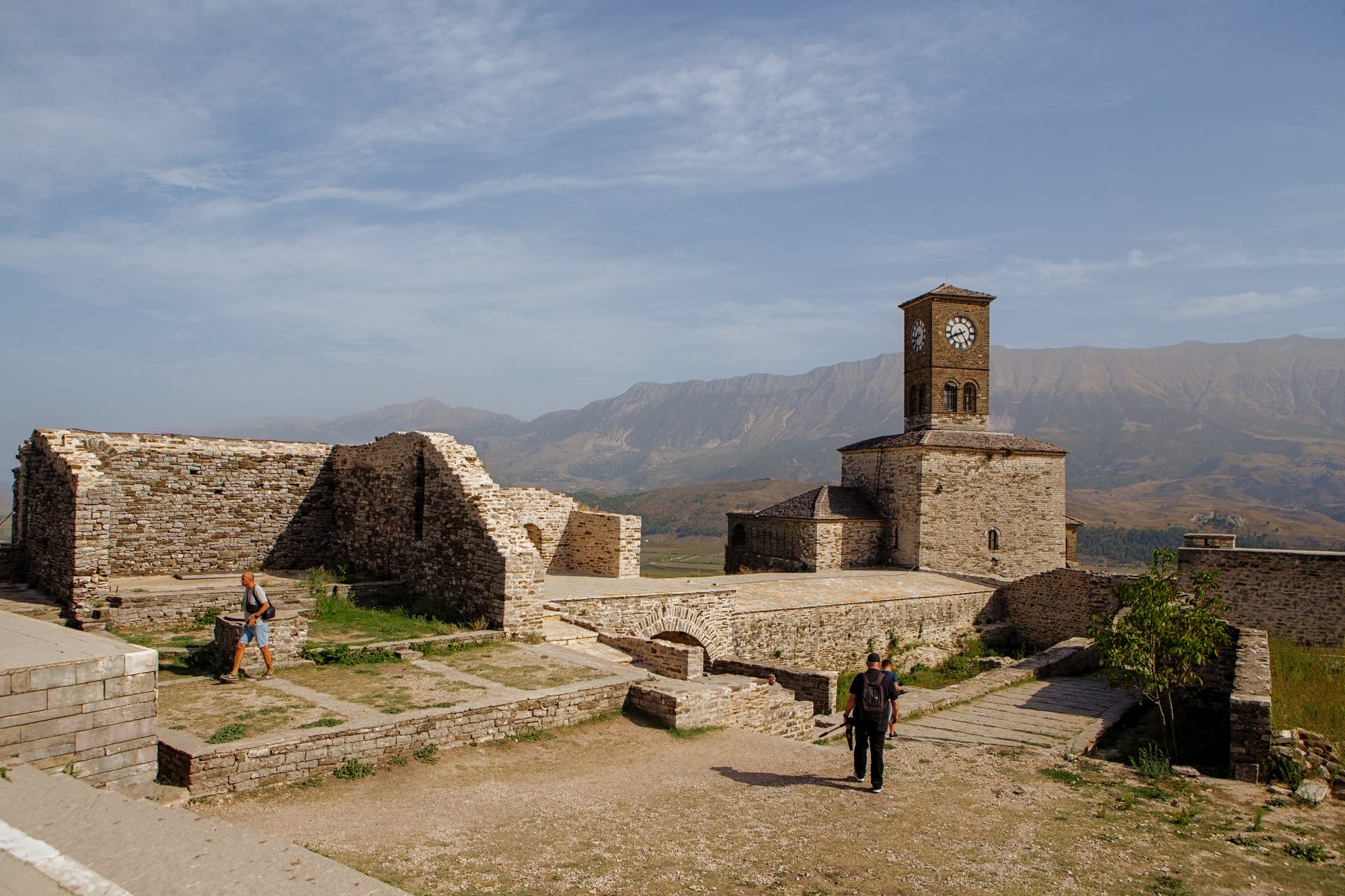

The Tower Houses
The kulla is the reason the town is a World Heritage site. A fortified Ottoman tower house, stone below and timber above, built by families who needed to defend themselves and wanted everyone to know they could afford to. The ground floors held animals and cisterns, the upper floors held the family and the guests, and the best ones have painted ceilings, carved wooden screens and rooms for every season.
Three are open, and they open in three different ways.
Zekate House (Shtëpia e Zekatëve), in Palorto, is the grandest. Built in 1811 and 1812 by an administrator in Ali Pasha’s government, with twin towers and a double-arched facade, three storeys of reception rooms and a cafe in the courtyard. Entry is 300 lekë, open daily from eight until late. This is the one to see if you see only one.
Skënduli House (Shtëpia e Skëndulëve), from the early 1700s and rebuilt in 1827, has twelve rooms, forty-four doors, sixty-four windows, nine fireplaces and four hamams, and the family who still own it will walk you through every one. Entry is around 200 to 300 lekë including the tour, open nine to seven from April to October; in winter you book ahead.
The Ethnographic Museum was built in 1966 as a model tower house on the site of Enver Hoxha’s birthplace, which had burned. There is nothing of Hoxha inside, deliberately, and it is now a well-arranged museum of how these houses were lived in. Entry is 500 lekë, daily nine to five.
Also in Palorto, the Kadare House is the family home where Ismail Kadare grew up and set his novel Chronicle in Stone. Built in 1799, gutted by an accidental fire in 1999, rebuilt with UNESCO money and opened as a museum in 2016, 200 lekë. Kadare died in Tirana on 1 July 2024, aged eighty-eight, and the house has been a place of quiet pilgrimage since.
The Cold War Tunnel (Tuneli i Luftës së Ftohtë) is the other thing under the castle. Eight hundred metres and fifty-nine rooms of nuclear bunker dug in the early 1970s for the local party leadership, opened to visitors in 2014. Tours run hourly from ten, take about twenty minutes, and cost 200 lekë; tickets are sold at the office beside the municipality building. It pairs naturally with the bunkers story and with Hoxha’s own beginnings a few streets up the hill.
The Bazaar and the Evening
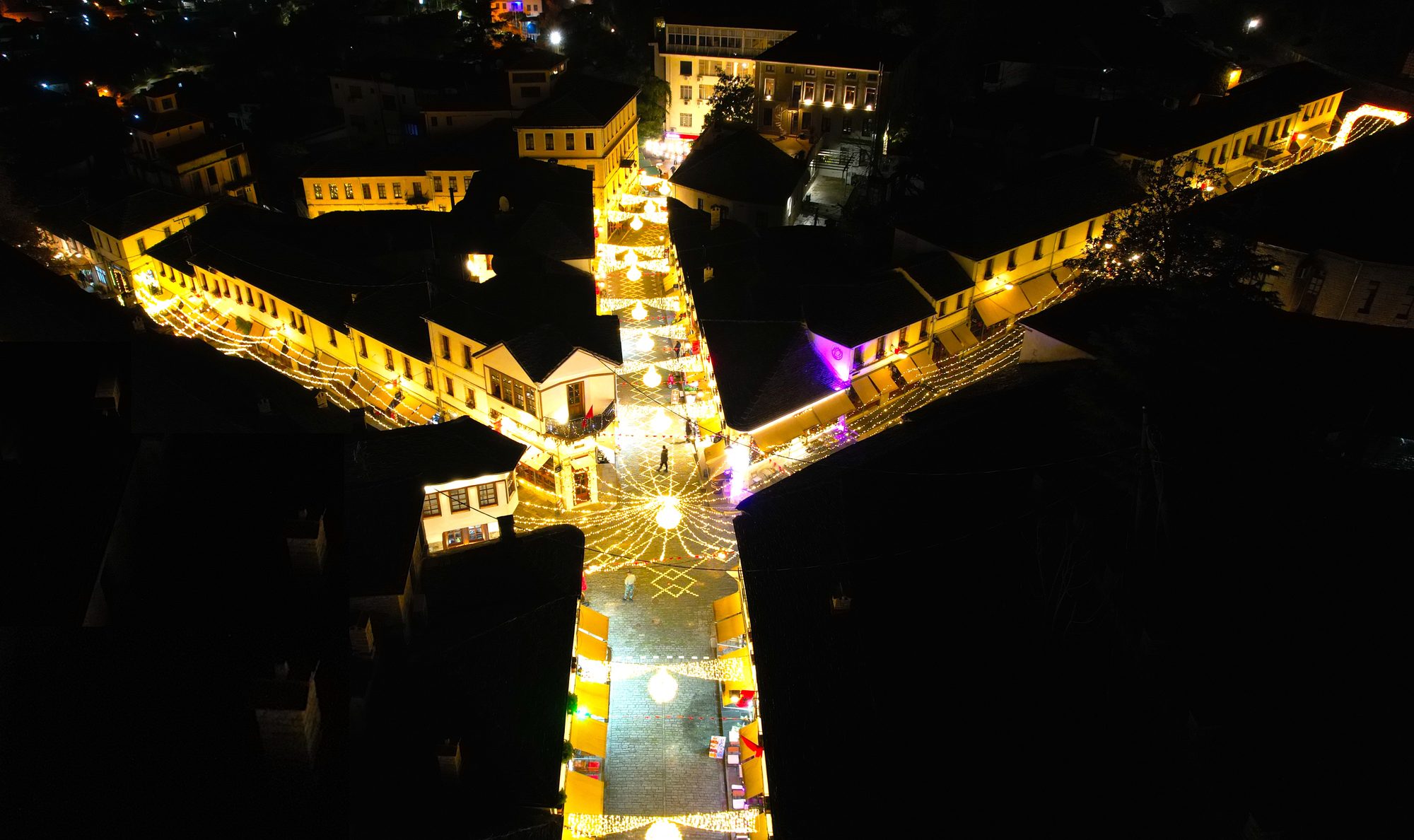

By day the bazaar sells slate ornaments, gliko in jars, embroidery and a great deal of the same souvenir. By evening it changes. Strings of lights come on across the lanes, cafe tables appear on every flat corner, and the town does its xhiro uphill, which I have written about in the promenades guide. It is the only evening walk in Albania where you need shoes with grip.
Look for the seven stone fountains near the Bazaar Mosque, the hamam behind it, and the obelisk on the ridge above the junction, put up in 1983 to mark the site of the town’s first Albanian-language school of 1908.
Eating
Gjirokastër cooks things nowhere else in Albania does, and the tavernas in the bazaar cook them well.
Qifqi first. Rice balls bound with whipped egg and dried mint, seasoned with pepper, fried in a special pan until the outside crisps and the inside stays soft. They look like nothing and taste like the whole town. Pasha qofte is a soup of small meatballs in a yoghurt and egg broth. Shapkat is a pie of cornmeal and sorrel. Oshaf is the pudding: sheep’s milk cooked down with dried figs and cinnamon, and better than that sounds.
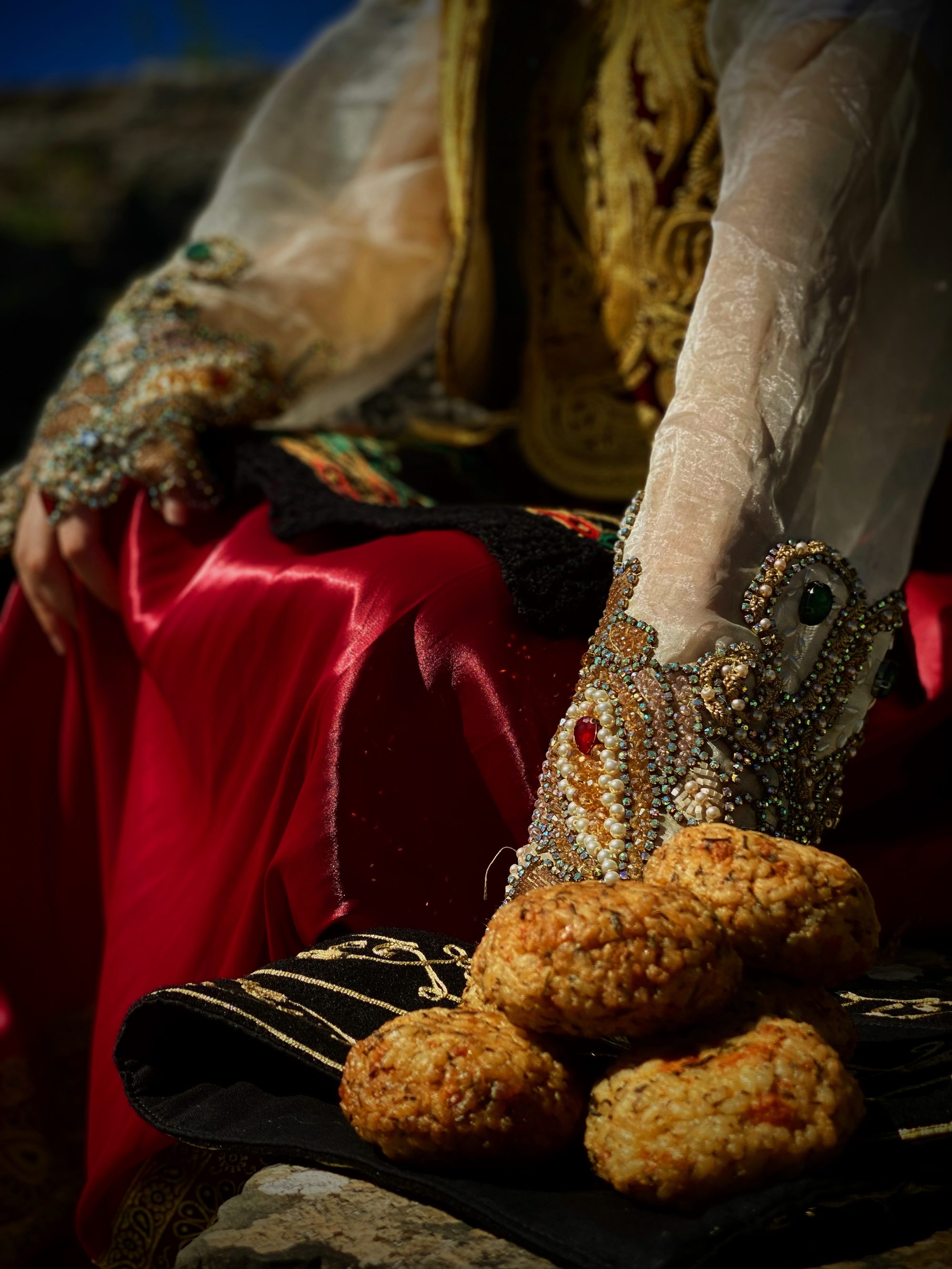

Kujtimi, in an alley off the bazaar, was the first private restaurant to open in the town after communism and still does qifqi, sarma and oshaf under a vine for 10 to 13 euro a head. It closes for the winter. Rrapi, at the edge of the bazaar under a plane tree two hundred years old, grills lamb and charges two people what one would pay on the coast. Odaja does qofte in yoghurt sauce and the best-value plate of qifqi in town. Taverna Kuka on Rruga Astrit Karagjozi does tavë kosi and stuffed aubergine for 500 to 1,500 lekë. Te Kubé, under the Bazaar Mosque, is the one for vegetarians.
The local cheese, a white brined djathë and a firmer kaçkavall, is considered the best in the country, and the gliko in the bazaar jars is the watermelon rind version I wrote about in the gliko guide. The raki is grape, strong, and poured before you sit down.
Around Gjirokastër
Antigonea. Fourteen kilometres and half an hour south-east, on a hill above Saraqinishtë, the city that Pyrrhus of Epirus founded in 295 BC and named after his wife, burned by the Romans in 167 BC and never rebuilt. Four kilometres of walls, an agora, a stoa and a sixth-century church mosaic, on a hilltop with nobody on it. Entry 200 lekë, open nine to seven in season. There is no shop and no shade, so bring water.
The Blue Eye. Thirty-six kilometres and forty minutes towards Sarandë, 50 lekë plus parking, and since 2023 swimming is banned. The full guide explains what changed and how to do it before the coaches.
Labova e Kryqit. Forty minutes north-east, the last stretch unpaved, a Byzantine church that is essentially thirteenth century with a legend that Justinian founded it, and a relic of the True Cross that vanished in 1989. The keys are with the custodian across the street. Donation.
Tepelenë. Forty minutes north up the Vjosa, Ali Pasha’s own town, with the walls of his 1819 castle along the river and his statue in the square. The road on to Berat runs through here, and the Berat guide picks up where this one leaves off.

Viroi, three kilometres north on the Tepelenë road, is a small karst lake with restaurants where the town swims and eats on summer evenings. The Ali Pasha bridge, the surviving span of the aqueduct that carried water ten kilometres from Mount Sopot to the castle cisterns, is a fifty-minute round trip on foot from Dunavat. Përmet, an hour and a half east through the Këlcyrë gorge, is thermal baths, gliko and the raki trail.
Getting There
From Tirana. Buses leave the North-and-South terminal on the Kamëz side of the city roughly every hour from five in the morning to half past eight at night, take about four hours inland via Fier and Tepelenë, and cost 1,000 to 1,200 lekë. Roadworks around Tepelenë added half an hour to an hour through 2026. The furgon guide has the rest.
From Sarandë. An hour to an hour and a half, 300 to 400 lekë, from beside the synagogue ruins on Rruga Flamurit. Ask which road: the direct one is quicker, the one over Muzinë passes the Blue Eye. A taxi is 35 to 45 euro.
From Berat. Two buses a day, at eight and two, about three hours via Fier and Tepelenë, 1,200 lekë. By car it is two and a half to three hours through the Vjosa valley and one of the better drives in the south.
From Greece. The Kakavijë crossing is thirty kilometres away, Ioannina about ninety. A minibus leaves the new town for Ioannina early each morning for around 8 euro, border included, and takes about three and a half hours.
Where you arrive. The bus station is at the entrance to the new town where the boulevard meets the main road. It is a thirty-minute uphill walk to the bazaar, which with luggage is not a walk, or a taxi for 300 to 400 lekë. There is also a local minibus loop between the two towns for a few lekë.
By car. The main road south from Tirana is good all the way. The old town is not: the lanes are steep, stone, one car wide and closed to traffic in places, and your phone will route you down them anyway. Park at the bottom or at the top and walk. Private parking in the old town runs about 1,000 lekë a day. If your southern days also take in the Blue Eye, Butrint and the coast, none of which connect well by bus, hire something; the Albanian agencies on Localrent will usually deliver to Sarandë, and what to refuse at the rental desk is worth reading first.
If you would rather not drive at all, the bus does Tirana to Gjirokastër perfectly well. It is the Gjirokastër to Berat to Sarandë triangle with luggage that defeats people, and there a driver booked for the one awkward leg costs less than a week of car hire.
Best Time to Visit
April to June and September to October. Warm, clear, the tower houses open, the bazaar lit in the evenings and the cobbles dry.
July and August bake. The valley holds heat and the afternoons reach 32 to 34 degrees on stone that has been absorbing sun since dawn. Do the castle at nine when it opens, the houses in the late afternoon, the bazaar after dark.
Winter is fog, 8 to 12 degrees by day, occasional snow, the castle closed on Mondays and a few of the smaller tavernas shut. It is also the town at its most itself. My November visit remains the one I think about.
When it rains, the streets become a hazard. Polished stone at an angle, and no handrails.
Where to Stay
Sleep in the old town, uphill, and accept that you will be walking on stone at an angle. The restored tower houses are the whole point of the place and staying in one is the way to understand it.
Hotel Kalemi, on Rruga Bashkim Kokona in the old town, is the classic, a family-run tower house with twelve rooms, carved ceilings and parking, at 60 to 80 euro. Hotel Gjirokastra, behind the Bazaar Mosque, has a pool and parking. Kerculla Resort, on the hillside above the old town up a road you will remember, has an infinity pool over the valley at 130 to 175 euro. Hotel Argjiro, on the square by the bazaar, is the big one with fifty rooms at 90 to 200 euro. Stone City Hostel at the start of the bazaar has beds from about 20 euro.
Do not book something modern in the new town to save fifteen euro. I said this in the where-to-stay guide and I will keep saying it.
Practical Tips
Cash. The castle, the houses, the tunnel, Antigonea and most tavernas.
Shoes with grip. Not sandals, not smooth soles. The cobbles have had four hundred years of polishing.
Two nights, not a day trip. Most people do the castle and lunch between Berat and Sarandë and leave saying it was fine. It is not fine, it is remarkable, and it needs one evening in the bazaar and one morning in the houses to prove it.
Do not pair it with Berat on consecutive days. They are both Ottoman UNESCO towns and they are nothing alike: Berat is white plaster and windows in a river valley, Gjirokastër is grey stone on a mountainside. Put the coast or Përmet between them, as the itinerary guide does.
Read something first. Chronicle in Stone, Kadare’s novel of a childhood in this town under Italian and Greek occupation, is short, and the town makes complete sense once you have read it. The house it was written about is on the hill in Palorto, and it is open.