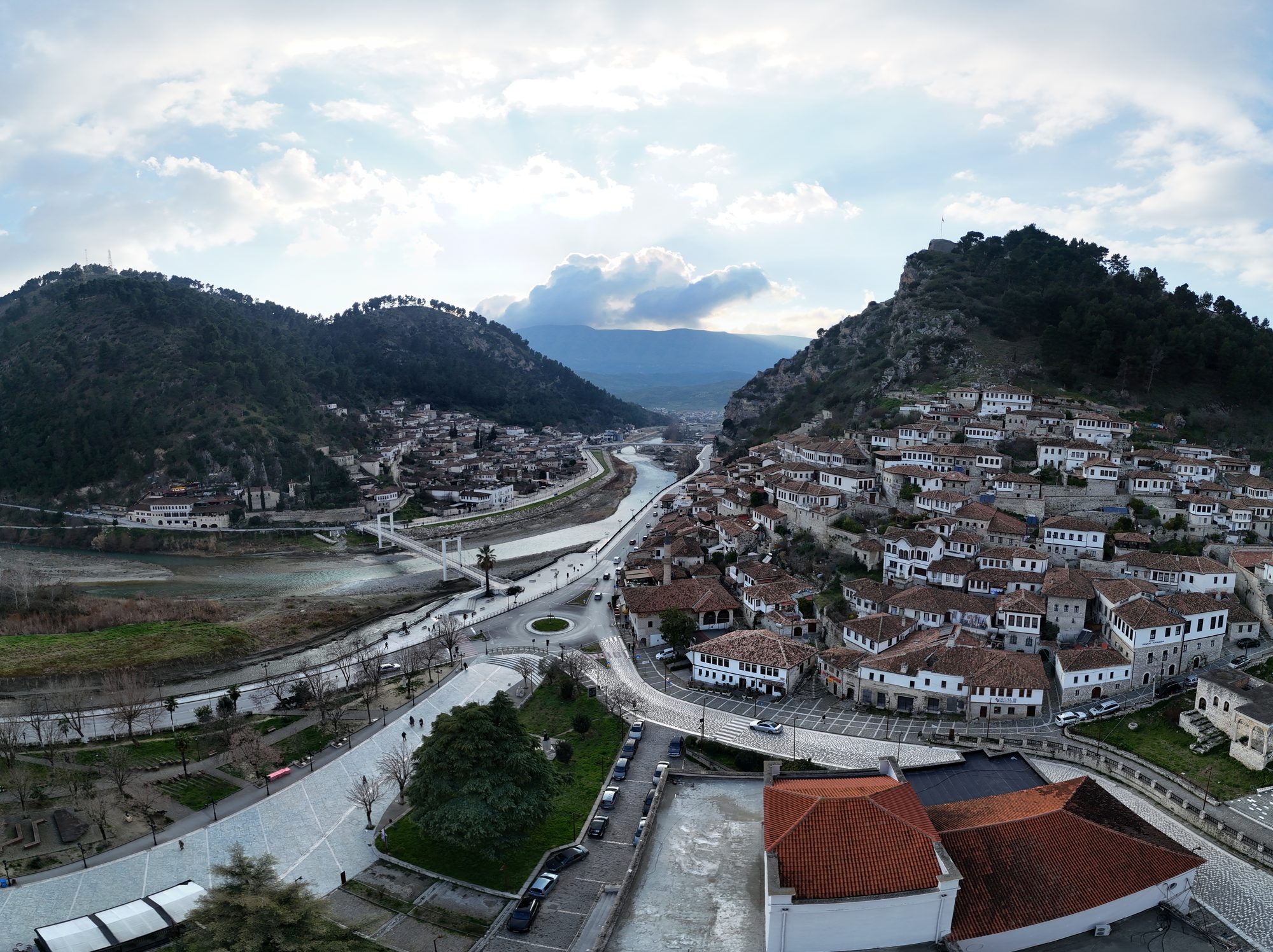
Berat’s nickname is the city of a thousand windows, and like most nicknames it is doing something more interesting than describing a view.
The white Ottoman houses stacked up the Mangalem hillside are arranged so that no house blocks the light of the one behind it. Every roof is set below the windows above. That is not an aesthetic accident, it is a rule, enforced by an 18th and 19th century town that had decided nobody’s neighbour was entitled to their sunlight. You are looking at a piece of civic law that happens to be beautiful.
Berat is a UNESCO World Heritage site, it is two hours from Tirana, and it is the town in Albania I send people to when they have room for exactly one Ottoman city and I want them to like the country.

Getting There
From Tirana: two hours. Furgons run frequently from the South terminal for 400 to 500 lekë. The road is good.
From Gjirokastër: two and a half to three hours through the Vjosa valley, which is one of Europe’s last free-flowing wild rivers and worth the stops.
From the coast: Vlorë is about two hours, Sarandë about four.
Do you need a car? For the city, no. Berat is compact and entirely walkable, and it is one of the easiest places in Albania to reach by furgon. For the wineries, the Osum canyon and the villages, yes. If you are doing those, the Albanian rental agencies will usually deliver to Berat rather than making you collect at the airport.
The Castle, Which Is Not a Ruin
This is the thing to understand before you climb up, because it changes how you behave once you are there.
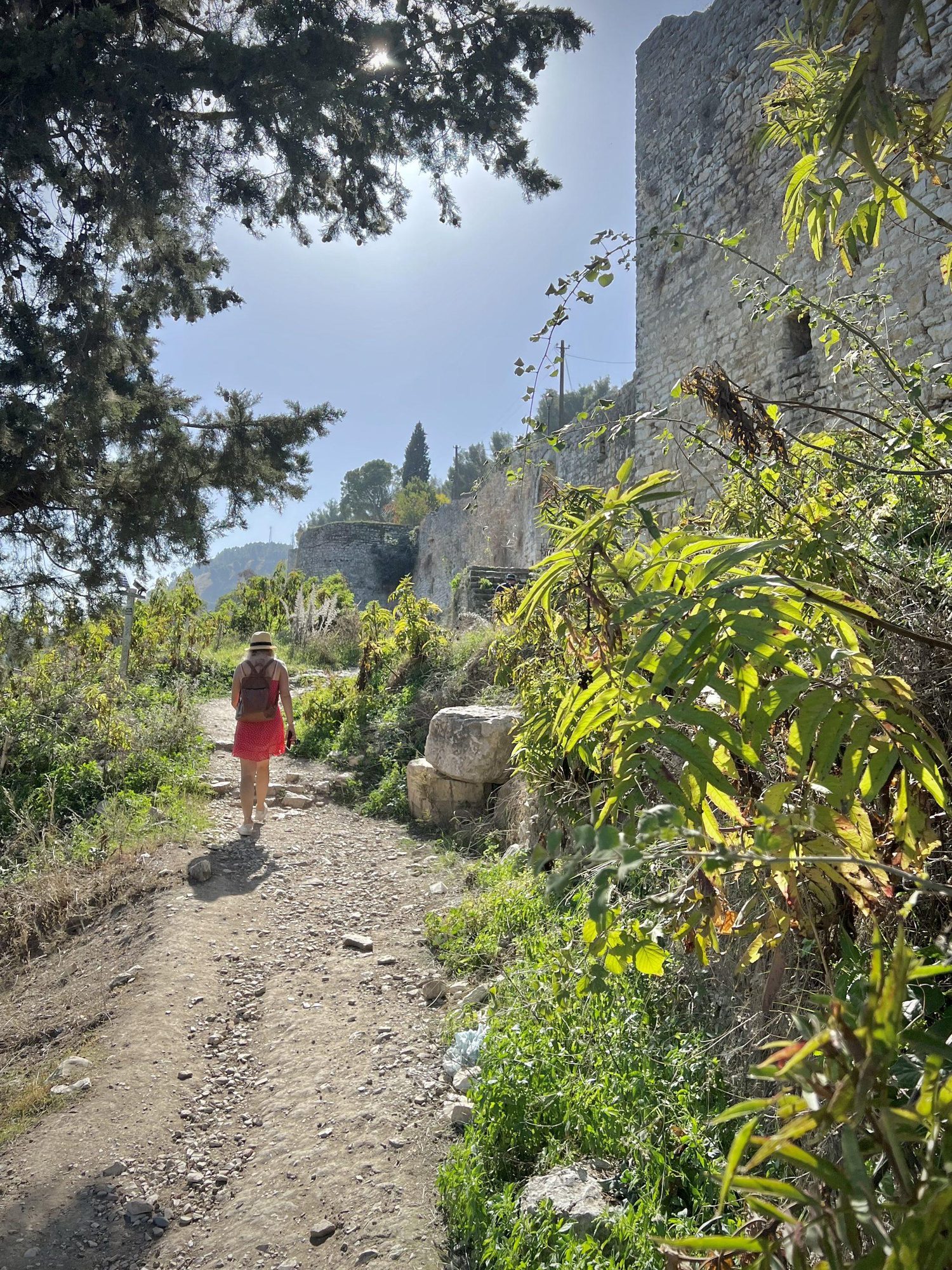
Kalaja e Beratit is an inhabited neighbourhood. Around a hundred families live inside the walls, in stone houses on cobbled lanes, and have done continuously for centuries. There is washing on lines between medieval towers. There are cats on Byzantine masonry. There are cars, badly parked, in a 13th-century fortress.
So when you walk through the main gate you are not entering a monument, you are entering someone’s street. Keep that in mind with your camera, particularly pointed at doorways.
Entry is 300 lekë, about three euro. Allow two to three hours.
Inside, look for:
- The Onufri National Iconographic Museum, in the Church of the Dormition, and the reason art historians come to Berat at all. Onufri was a 16th-century icon painter who made a red nobody has satisfactorily reproduced since. Entry is separate and small.
- The Church of the Holy Trinity, 14th century, red brick dome, sitting on the slope below the walls with the whole valley behind it.
- The ruins of the Red Mosque and its standalone minaret.
- The viewing platform at the western end, looking down over Mangalem, the Osum, and out to Mount Tomorr.
Of the dozens of churches that once stood within the walls, fewer than ten survive in various states, which still tells you something about how Berat worked: an Ottoman-governed town whose fortress quarter stayed largely Christian, with the mosque quarter below it, for four hundred years.

Mangalem and Gorica
The two old quarters face each other across the Osum, connected by a stone footbridge.
Mangalem, on the castle side, is the famous facade. Narrow lanes, whitewash, the King Mosque and the Bachelors’ Mosque, and the walk up to the castle gate. It is the postcard.
Gorica, on the far bank, is where you should sleep. It is quieter, the guesthouses are cheaper, and crucially you get the view instead of being in it. Standing in Mangalem, you cannot see Mangalem.
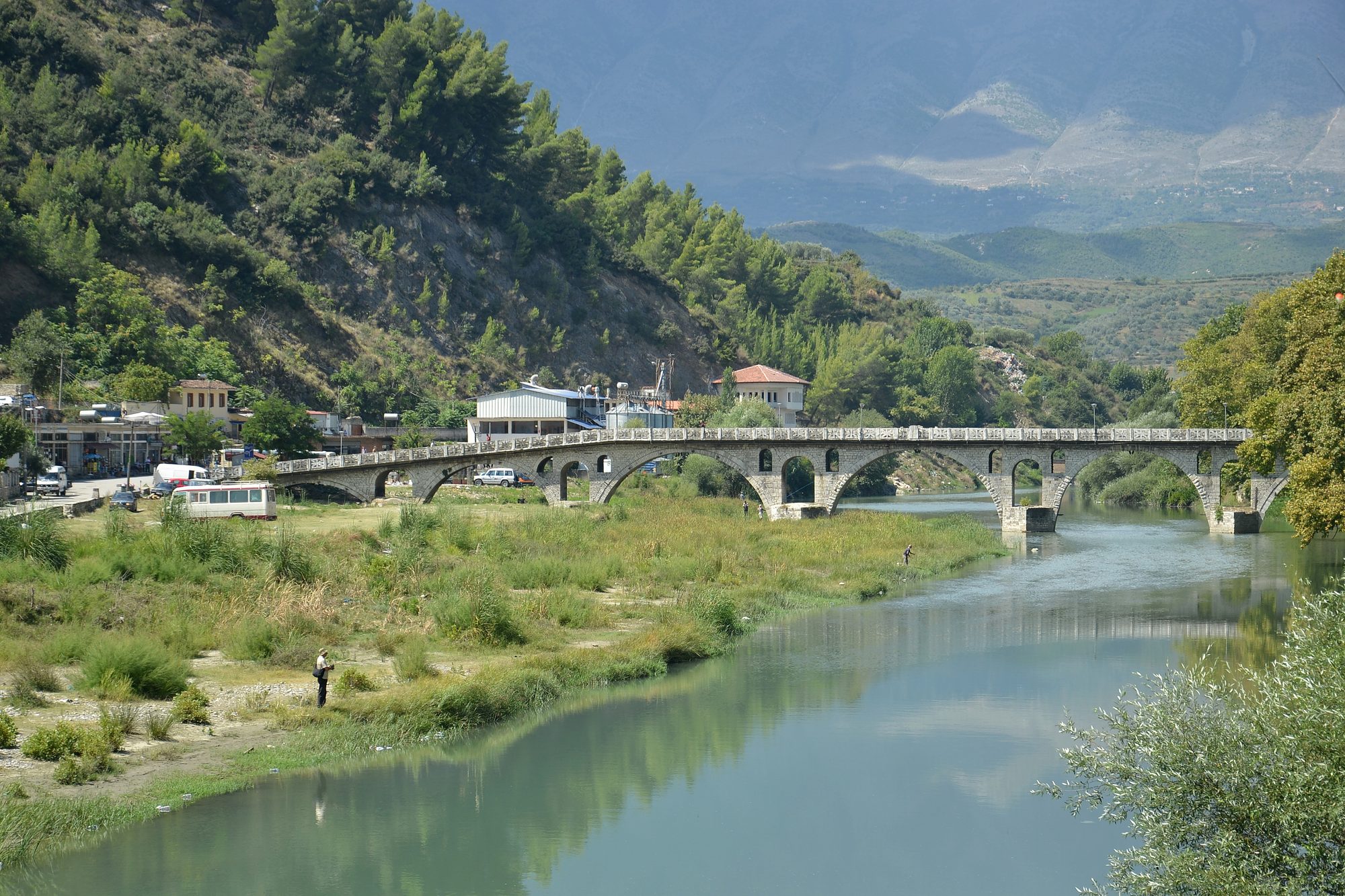
The Gorica bridge is the connective tissue. Seven arches, first built in wood in 1780, rebuilt in stone in the 1920s, and the single best place in the city at dusk. Cross it at seven in the evening in September and the whole hillside is on.
.JPG)
Wine, and a Confession
Berat is the centre of Albanian wine, and Albanian wine is genuinely one of the country’s better-kept secrets. The indigenous grapes are the interesting part: Shesh i Zi and Shesh i Bardhë, black and white, Albanian natives grown almost nowhere else on earth.
Çobo and Nurellari are the two estates most set up for visitors, both a short drive from town, both doing tastings with food. Ninety minutes to two hours is the right length. Nurellari’s Montemeca took the prize for best Albanian wine back in 2011 and the estate has traded on it comfortably ever since, which is fair enough.
Here is the confession. My father is from a village outside Berat, and my grandfather still runs the raki courtyard there, distilling every autumn as he has done my whole life. I grew up understanding this region through the still rather than the barrel. So when I tell you Berat’s wine is worth your afternoon, take it as the opinion of someone whose family would probably rather you drank something else.
Both, ideally. The order matters and it is wine first.
Beyond the City
The Osum canyon, about an hour southeast. Twenty-six kilometres of gorge, up to eighty metres deep in places. Rafting in spring when the water is high, swimming and scrambling in summer when it drops. This is a full day and one of the better ones in central Albania. Keep going past the canyon and you are in Skrapar’s raki country; the raki trail turns that into a two or three day loop through Çorovoda and on to Përmet.
Mount Tomorr, the mountain you can see from everywhere in Berat, is a sacred site to the Bektashi order with a pilgrimage every August to the tekke near the summit. If your dates fall in the last week of August, it is an extraordinary thing to witness, and it deserves more respect than a photo opportunity.
The villages in the hills either side. This is where the food is, where the raki is, and where nobody is running a tour.
Best Time to Visit
May, June, September and October. Berat sits inland in a valley and July and August genuinely bake; it can push past 38 degrees and the climb to the castle is unshaded.
The light is the whole argument. Mangalem faces roughly southwest, so the facade lights up in the last two hours before sunset. That is the hour to be on the Gorica bridge or on the castle platform. Midday is flat and hot and does the town no favours.
Winter is lovely and empty. Snow on Tomorr, nobody in the castle, guesthouse prices halved.
Practical Tips
Two nights, not one. Berat is the town most commonly done as a day trip from Tirana and most commonly ruined by it. Four hours of driving for five hours in a town whose best hour is at seven in the evening is a bad trade. The itinerary guide gives it a night, and ten days gives it two.
Wear proper shoes. Cobbles, steep, polished by four hundred years of feet, lethal in the wet.
Do not drive into the old quarters. Both Mangalem and the castle approach have lanes your phone will happily route you down and that you should not attempt. Park at the bottom.
Carry cash. Castle entry, museums and most guesthouses prefer it.
Eat where the locals go, which in Berat means slightly away from the Mangalem waterfront. The riverside restaurants are fine and priced for the view. Walk five minutes and pay two thirds.
Combine with Përmet or Gjirokastër, not with the coast. Berat looks close to the sea on a map and is not, in Albanian road terms.
Berat or Gjirokastër?
People ask this constantly, having read that both are Ottoman UNESCO towns and assumed they are interchangeable. They are not remotely alike.
Berat is white plaster, windows, a river valley, a living castle quarter, and wine. It is gentler, greener, and easier to love on a first visit.
Gjirokastër is grey stone, fortified tower houses, slate roofs like fish scales, and a mountainside. It is harsher and more dramatic and has the better castle as a monument. I have written a full guide to it.
If you have time for one, take Berat. If you have time for two, take both, and do not put them next to each other in the itinerary.
If you are coming down from Tirana without a car and want the wineries and canyon as well as the town, a driver booked for the transfer and a taxi arrangement locally will still come to less than a week of car hire, and you can drink at the tasting.